
I earned two technology degrees a little over thirty years ago. I haven’t written a line of production code in more than twenty five. My career has focused on developing the potential in people by building relationships, teams, and companies. I’ve worked with talented folks that build software. The real shift for me has been creating a vision and aligning with others to vigorously pursue it. This happened long before anyone was talking about AI.
I’ve led through a handful of tectonic shifts since then. This is the fastest one. Faster than the internet. Faster than mobile. Faster than the cloud. What hasn’t shifted an inch in thirty years is the people on the team who are counting on me. Yours are counting on you. They are counting on you to make the best decisions you can, with whatever’s sitting in front of you.

The organizations that get through a shift like this aren’t the ones with the best tools. They’re the ones led by people who grow faster than the moment demands. I’ve experienced that truth every time. AI isn’t the exception.
AI is putting a spotlight on the leadership capacity crisis that already exists. My clients and colleagues have been working though complexity challenges way before ChatGPT arrived. This is just the loudest pressure test to show up in thirty years, and it’s coming at you from three directions at once.
From inside, where your team is already using AI tools, sanctioned or not. From outside, where your customers and your competitors want your response to the AI question. From above, where your board, investors, and your lenders expect a strategy, not a shrug. Three directions. One question underneath all of them: can you actually lead through this?
I’m building a deeper map of this pressure test for the session at the DAC — the details we’ll walk through together there.
None of this changes what you’re actually responsible for. Setting direction. Aligning your team. Allocating resources. Removing what’s in the way. Modeling the behavior you want to see. In fact, I see five jobs that leaders must embrace. AI has not added a sixth. It just turned up the volume on all five – more on that in Part II.
What AI has done is make the Law of the Lid visible. John Maxwell’s line still holds: an organization can’t outperform the capacity of its leader. That’s not a new law. AI just took away the places to hide from it.
Where this turns from concept to reality is value. Not efficiency. Not adoption. Value. Is what your organization produces worth more to the market because of how you’re leading through this? No one cares if you bought the tool. I’ve watched leadership teams get the economics, the governance, and the change management mostly right and still miss this, because value isn’t a work stream. It’s a leadership outcome.
It’s an outcome of whether you’ve grown enough to see where value is actually being created now and whether your team trusts you enough to tell you when you’re wrong about it. Get the value question right and the other three pressures tend to resolve themselves.
The leaders pulling ahead right now aren’t the ones with the biggest AI budget. They’re the ones willing to expand their own thinking, tolerate being challenged, and invite the dissent most rooms are still too polite to offer. They use AI as a thought partner. Not a shortcut. A partner. The kind that pushes back.
Growth doesn’t break companies. Undeveloped leadership teams and cultures do.
AI just handed you the mirror faster than anything else has. The question isn’t whether you’ll use it. It’s whether you’re willing to see what it shows you.
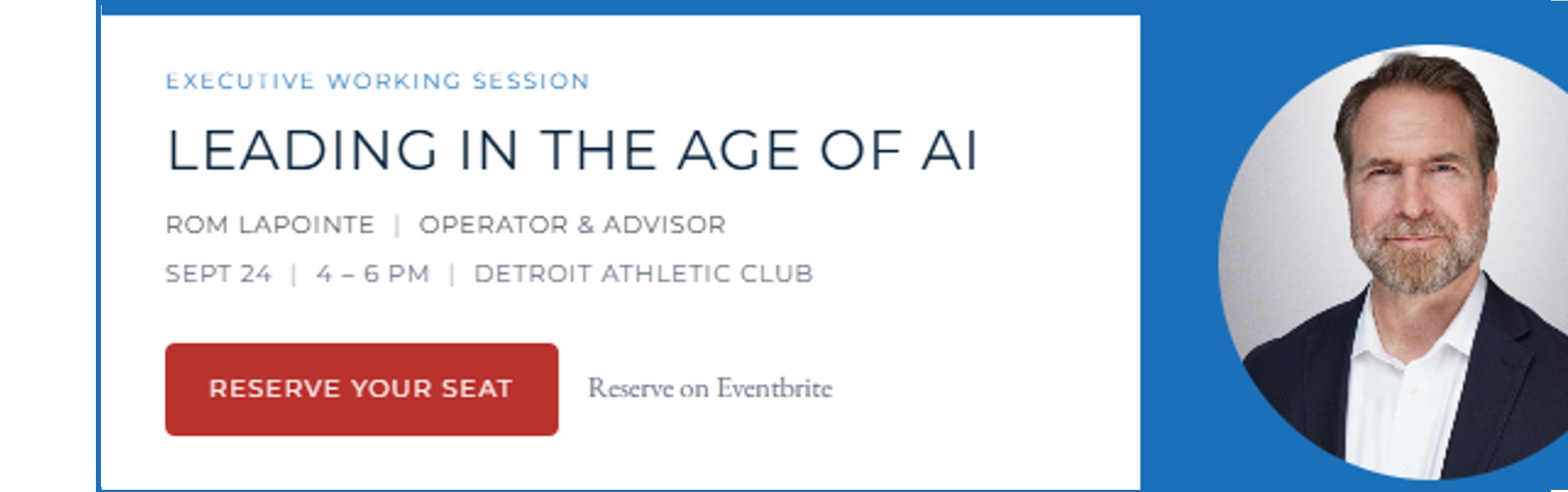
This is the exact terrain we’re covering at Leading in the Age of AI, presented by Cygnus Systems at the Detroit Athletic Club. Not tools. Not hype. Leadership — for the leaders who still care enough to ask the harder question.
Details and registration: Leading in the Age of AI
Part II will break down the CEO’s five jobs in detail and show how they apply directly to AI decisions.